


It’s 9:00 PM. You opened Circle to do one thing. Forty minutes later you have replied to six posts, walked someone through a login problem, welcomed two new members, and noticed three people who have not said a word since March.
None of that was on your calendar. All of it needed doing.
That is the question underneath when to hire a community manager. Not whether the work is important, because you already know it is. Whether it should keep being you doing it.
Here is what the job actually consists of, what it costs to hand off, and the honest reason I hired someone before the numbers said I should.
What Does a Community Manager Actually Do All Week?
The job is mostly small and constant: notifications, replies, welcomes, tech questions, and the people who need a human. The strategy work everyone pictures is the smallest part of it.
That is the thing founders get wrong when they try to scope this role. They write a job description full of engagement strategy and content calendars, and then the person spends most of their time answering “I can’t find the replay” for the fourth time this week.
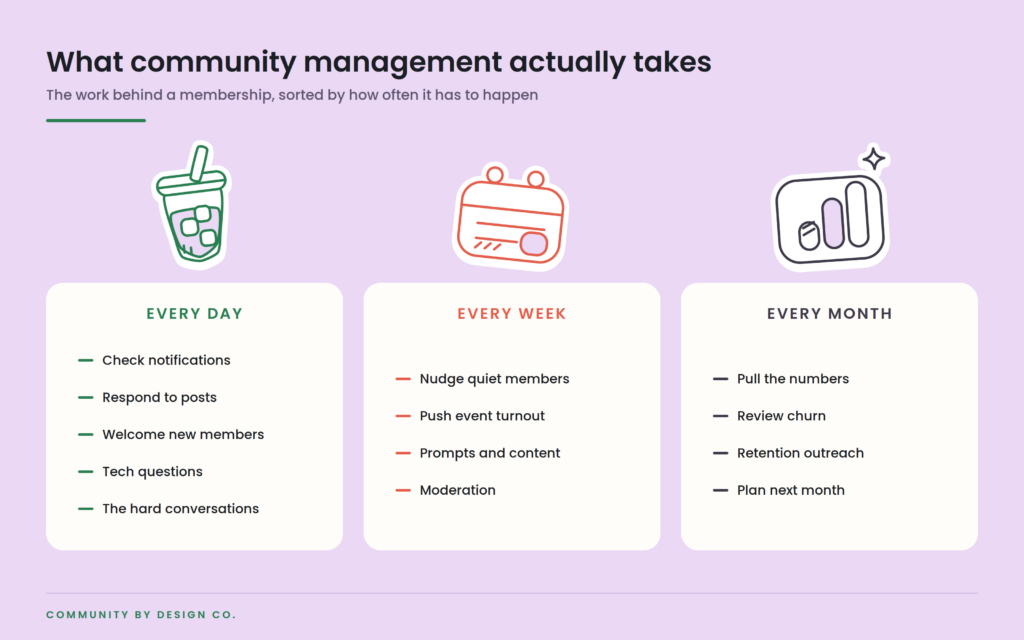
The work that happens every day
Miss a day of this and members feel it before you do.
What that looks like:
- Checking notifications and clearing what came in overnight
- Responding to posts so nobody’s contribution sits there alone
- Welcoming new members individually, not with an automation
- Tech support, which is most of what people actually ask for
- Emotional support, sometimes, because people bring real things into a community they trust
The work that happens weekly
This is the part that gets dropped first when you are busy, and dropping it is what turns a community quiet.
What that looks like:
- Nudging members who have gone silent, before silence becomes a cancellation
- Driving attendance for whatever is on the calendar
- Prompts and content, so there is something to respond to
- Moderation, which is light most weeks and occasionally is not
The work that happens monthly
Nobody misses this until a quarter has gone by and you cannot answer a basic question about your own membership.
What that looks like:
- Pulling the numbers out of the platform
- Looking at churn honestly instead of hoping
- Reaching out to people who are on their way out
- Deciding what next month looks like based on what you found
The Part of the Job That Does Not Look Like the Job
Ask a founder what community management is and they describe posting. Ask a community manager and you get tech support, retention outreach, and being the person who noticed someone was struggling.
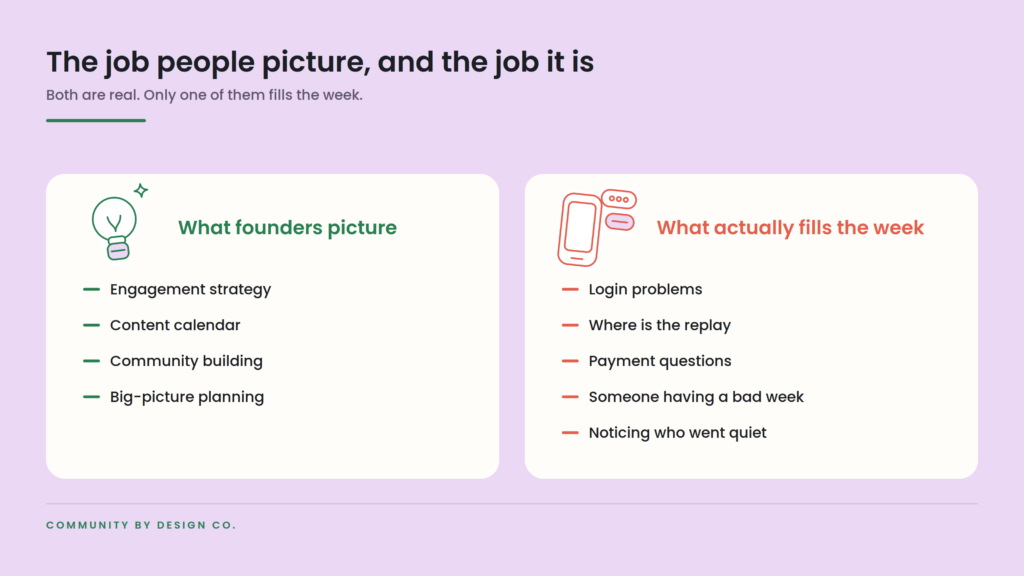
Tech support is the volume item. Login problems, notification settings, missing replays, payment questions, someone who cannot find the thing that is on the home page. None of it is hard. All of it takes a response, and every response takes attention you were spending on something else.
The emotional support is the part nobody warns you about. Build a community people actually trust and they will bring you real life. That is not a failure of your boundaries. It is the thing working. But it is labor, and it is the labor that does not fit in a fifteen minute gap between calls.
Retention is the other one. Quiet members do not announce themselves. Somebody has to notice, and noticing is a job. This is also why what happens with your first ten members matters more than your first hundred: at that size you can notice everything yourself. Past it, you cannot, and the drift starts.
And none of this is work you can hand to a bot. There is a real line on what AI should touch in a community, and the noticing sits firmly on the human side of it.
What Does a Community Manager Cost?
I have seen community managers paid anywhere from $500 a month to over $5,000 a month. The spread is not about seniority. It is about what the community demands of them.
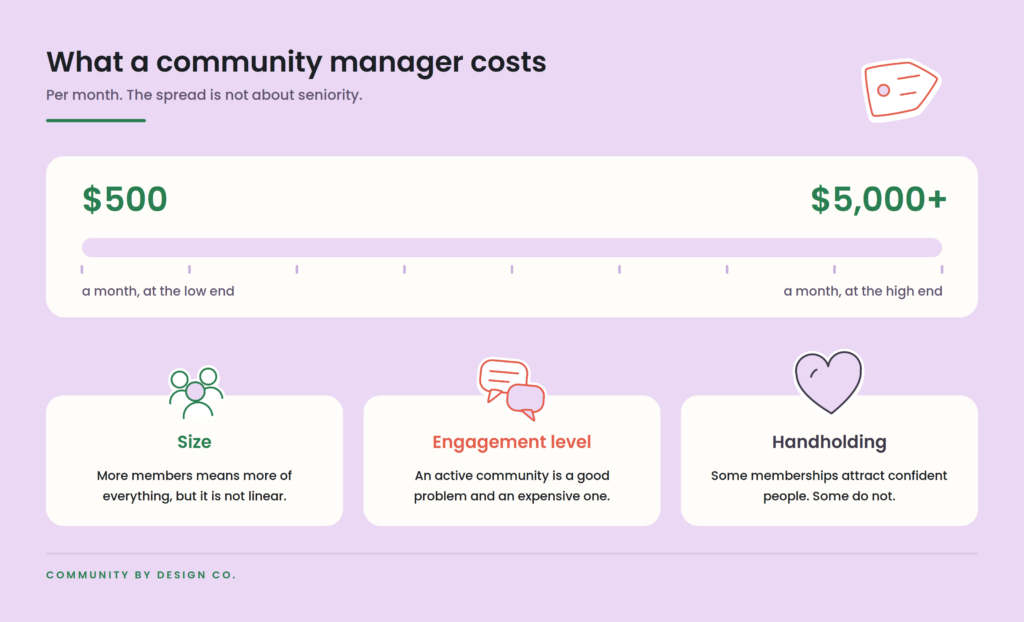
Three things move the number:
- Size. More members means more of everything, but it is not linear. A large quiet community can be less work than a small intense one.
- Engagement level. An active community is a good problem and an expensive one. Every post needs a response.
- How much handholding is required. Some memberships attract people who are confident with the tech and each other. Some do not. That difference is worth thousands a month.
So the honest answer is that you cannot price this from member count alone. Look at your actual week first. If your community generates twenty conversations a day and half of them need you specifically, you are at the top of that range whether you have two hundred members or two thousand.
One more thing worth saying plainly. The cheap end of that range buys you coverage, not judgment. Someone reliable who clears notifications and welcomes people is genuinely valuable, and it is not the same hire as someone who will notice your churn pattern and tell you about it.
When Does It Actually Make Sense to Hire?
You can do the math. Take the hours you spend on the list above, put your own hourly rate against them, and compare that to the range. For most founders past their first year, the math says hire.
But I want to be honest about something, because the math is not why I did it.
I hired a community manager well before it made sense financially. It was money I did not obviously have to spend, on a role I could technically still cover myself. I did it because the burden was on me every single day and I wanted it off.
That was worth something. Not something I could put in a spreadsheet, but something. The daily weight of being the only person responsible for whether the room feels alive is a real cost, and it comes out of you somewhere, usually out of the parts of your business nobody else can do.
So here is the caveat I would give anyone. If your revenue is real and predictable, and the daily work is what is grinding you down, you are allowed to buy your way out of it earlier than the numbers justify. If your revenue is not real yet, that is a different conversation, and the answer is probably to shrink the job rather than to hire it out.
What I would not do is wait until you are already resentful of your own community. By then members can feel it, and you are hiring someone to fix a mood, which is a much harder job than the one you meant to give them.
Try This Prompt
Before you can hire for this or shrink it, you need to know what your week actually contains. Most founders have never written it down.
“I run a paid membership community for [who] with roughly [number] members on [platform]. Here is everything I do for it in a typical week: [list it out, including the small things]. Sort this into work that has to happen daily, work that can be batched weekly, and work that only happens monthly. Then flag which items genuinely require me specifically and which could be done by someone else with good training. Give me the output as a table with a column for what I would need to document before handing each one off.”
It drafts the audit. You decide what only you can do, which is usually less than you think and more than you want it to be.
If you want the templates for documenting a handoff, they’re in the free resources hub.
What This Is Really About
The job is not hard. That is what makes it so easy to keep doing yourself, and so easy to underestimate what it takes out of you.
A community manager is not a luxury you earn once the membership is big enough. It is the difference between a community that has someone paying attention to it every day and one that has someone getting to it when they can. Members can tell which one they are in, even if they could never name it.
You built a room for other people. You do not have to be the only one holding the door.
More From Your Community Strategist
Not every episode has a video version, but the channel is where the walkthroughs live: Circle builds, settings, and setups on screen instead of described out loud. New videos every Thursday.
More Like This
Listen: Your First 10 Members Matter More Than Your First 100. Why the noticing is the whole job when your community is small.
Listen: What Your Community Actually Needs on Day One. What you are setting up on day one is what someone has to maintain every day after.
Listen: What You Should Never Let AI Do in Your Community. Before you try to automate your way out of hiring, this is the line.
Keep Going
If you would rather not do this part alone, Rachel and the team build, migrate, and run communities for founders who need it done properly the first time. Talk to the team
coCreator Society is where community builders and membership founders work through this together, with the templates, the walkthroughs, and people who are one step ahead of you. Join coCreator Society


Comments +
Comments